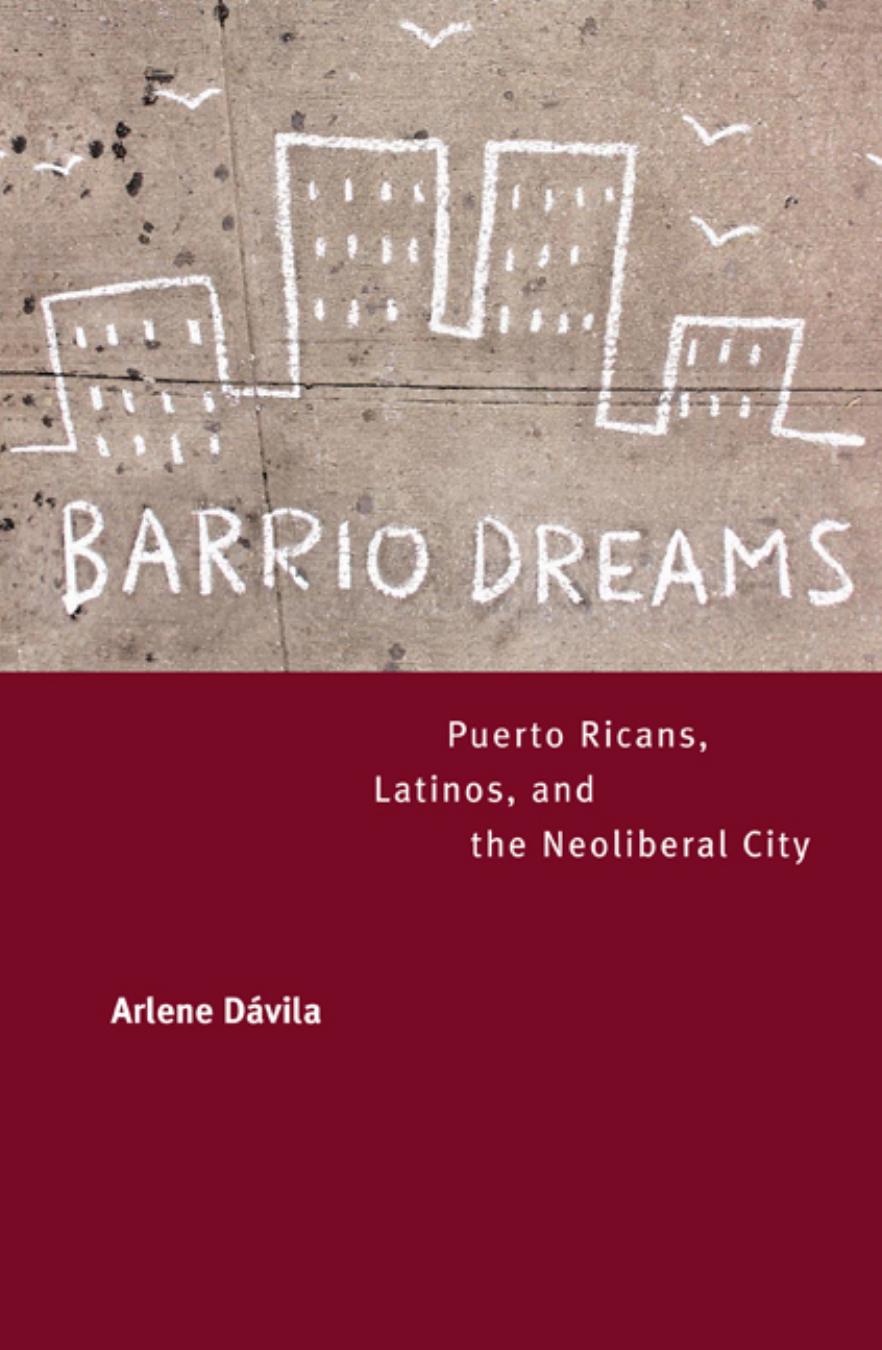
Barrio Dreams: Puerto Ricans, Latinos, and the Neoliberal City by Arlene Dávila
Author:Arlene Dávila [Dávila, Arlene]
Language: eng
Format: epub, pdf
Tags: USA, Geografia
Publisher: University of California Press
Published: 2004-07-01T22:00:00+00:00
GENTRIFICATION WITH KENTE CLOTH COVER
No one could deny that Edison had done its homework. After a much publicized defeat in 2001, when New York City parents voted against Edison and its bid to manage five public schools in Brooklyn, Manhattan, and the Bronx, Edison could not afford to lose the battle in East Harlem. In the months prior to the hearings during the summer of 2001, Edison engaged in aggressive public relations operations with strong advocacy and many presentations to community groups. First they hired Tonio Burgos, a nationally recognized lobbyist with deep political roots in East Harlem, where he served on the school board and the community board, and was well connected with longstanding Puerto Rican political leaders in the area. Burgos in turn hired Francisco Díaz, a current resident and former state assemblyman and member of the school board and community board as community consultant for the project.3 Both had similar trajectories in the civic sector before moving to the private sector, although Díaz's newcomer status in the world of lobbying added to his image as a community-concerned and neutral insider, not solely an advocate for Edison.4 Guided by Diaz's local knowledge, Edison engaged in a massive grassroots effort including multiple presentations to sell the project among influential prodevelopment organizations in the area, from Hope Community to East Harlem Council for Community Improvement to the Community Board 11 Committees on Economic Development, Zoning, Public Safety, Transportation, Parks and Recreation, and Cultural Affairs. In each forum, they spoke seductively about their proposed contributions to East Harlem, although many issues were left unanswered. During a presentation at the Cultural Affairs Committee, for instance, they described their curatorial vision for the museum as a diasporic one encompassing Afro-Caribbean culture and heritage, signaling here Puerto Rican and Dominican culture, a highly effective move for neutralizing concerns about the museum's cultural alignment with El Barrio. But the museum has in fact never cultivated this vision. As of 2002, among more than forty exhibitions since 1984, only one evoked directly the African legacy in the Americas: “Face of the Gods: Art and Altars of Africa and the African Americas.” Far from evidence of a diasporic vision, this exhibition represents an exception from a primarily continent-centered African approach that leaves little room for African diasporic arts and culture, much less for Hispanic Caribbean or Afro-Latino cultural expressions, as residents had been promised.5
Through these presentations, the Edison Project accumulated friends and preliminary endorsements, which they quickly publicized in order to recruit additional supporters. The Edison team made so many visits to the different community board committees that an African American member assured me that she supported the project but had become “sick of the Edison people.” In preparation for the public hearing, “the Edison people” had also called upon teachers and African-garbed volunteers, some coming from Boston and Washington, D.C., to testify about the wonders of Edison Schools, replete with African greetings and exhortations of “our common African ancestry.” One supporter summoned “the ancestors,” linking community approval of the project with the appeasement of those absent yet “watching us from above.
Download
Barrio Dreams: Puerto Ricans, Latinos, and the Neoliberal City by Arlene Dávila.pdf
This site does not store any files on its server. We only index and link to content provided by other sites. Please contact the content providers to delete copyright contents if any and email us, we'll remove relevant links or contents immediately.
Cecilia; Or, Memoirs of an Heiress — Volume 1 by Fanny Burney(32558)
The Great Music City by Andrea Baker(32019)
Cecilia; Or, Memoirs of an Heiress — Volume 2 by Fanny Burney(31956)
Cecilia; Or, Memoirs of an Heiress — Volume 3 by Fanny Burney(31942)
We're Going to Need More Wine by Gabrielle Union(19046)
All the Missing Girls by Megan Miranda(16029)
Pimp by Iceberg Slim(14508)
For the Love of Europe by Rick Steves(14121)
Bombshells: Glamour Girls of a Lifetime by Sullivan Steve(14076)
Talking to Strangers by Malcolm Gladwell(13370)
Norse Mythology by Gaiman Neil(13366)
Fifty Shades Freed by E L James(13243)
Mindhunter: Inside the FBI's Elite Serial Crime Unit by John E. Douglas & Mark Olshaker(9344)
Crazy Rich Asians by Kevin Kwan(9292)
The Lost Art of Listening by Michael P. Nichols(7506)
Enlightenment Now: The Case for Reason, Science, Humanism, and Progress by Steven Pinker(7314)
The Four Agreements by Don Miguel Ruiz(6765)
Bad Blood by John Carreyrou(6622)
Weapons of Math Destruction by Cathy O'Neil(6281)
